
ABAC adopts recommendations for APEC Leaders as Philippines highlights what matters most for Filipino workers, businesses, and communities
BANGKOK, Thailand, 9 July 2026 — Business leaders from the 21 APEC economies today concluded the Third Meeting of the APEC Business Advisory Council (ABAC), held from 6 to 9 July in Bangkok, adopting recommendations on artificial intelligence (AI), trade, connectivity, food security, and sustainable growth that will be presented to APEC Economic Leaders later this year. Representing the Philippines, ABAC Member Mr. Kevin Tan advanced Philippine priorities on AI and sustainability while chairing the ASEAN-ABAC Caucus, which brought together ASEAN business leaders and dialogue partners to identify practical regional initiatives.
Under the theme “Openness. Connectivity. Synergy.”, ABAC reaffirmed its support for free, open, fair, non-discriminatory, transparent, and predictable trade and investment while advancing practical business recommendations to strengthen regional competitiveness, resilient supply chains, innovation, and connectivity. The recommendations will be presented to APEC Economic Leaders during the annual Dialogue between ABAC and APEC Leaders in November this year.
“The discussions at ABAC reaffirm that deeper regional cooperation is not just good for businesses and industries—it is good for every Filipino,” said Mr. Kevin Tan, ABAC Philippines Member and President and Chief Executive Officer of Alliance Global Group. “By advancing free trade, digital connectivity, resilient supply chains, and sustainable investment across the Asia-Pacific, we can create better jobs, attract higher-quality investments, empower our MSMEs, and ensure that the Philippines shares more fully in the region’s growth and prosperity.”

Tan said several of the recommendations adopted by ABAC carry particular significance for the Philippines as the country prepares for an AI-driven economy, strengthens its digital competitiveness, and expands opportunities for Filipino workers, businesses, and investors.
First among these is ABAC’s recommendation to accelerate AI adoption across APEC economies through greater investment in workforce upskilling and digital capabilities. For the Philippines, this reinforces the need to invest in AI education, workforce development, and digital capability-building by leveraging expertise and best practices across APEC. Preparing Filipino workers, professionals, entrepreneurs, and students for the opportunities and risks presented by AI will be essential to ensuring the country remains competitive and that more Filipinos can benefit from the next wave of technological transformation.
ABAC also recommended greater alignment in modern data legislation and common digital standards to support the responsible development and deployment of AI. These efforts reinforce the importance of strengthening the country’s governance framework to encourage innovation while establishing safeguards that build public trust and better protect Filipinos from the misuse of AI and other emerging digital technologies.
ABAC likewise urged stronger regional cooperation against cross-border online fraud and scams through closer policy coordination and law enforcement collaboration. As cyber-enabled crimes become increasingly sophisticated and operate across multiple jurisdictions, closer regional cooperation will be essential to strengthening the Philippines’ efforts to protect individuals, businesses, and digital transactions.
Business leaders also emphasized that AI adoption must be matched by investment in sustainable digital infrastructure. Expanding energy-efficient digital infrastructure and data centers will enable the Philippines to support growing AI demand while balancing long-term energy security and sustainability.
Food security also remained high on ABAC’s agenda. ABAC recommended reducing non-tariff barriers affecting food trade to strengthen regional supply chains and improve resilience against future disruptions. For the Philippines, stronger regional food cooperation can help improve resilience during supply shocks while contributing to more stable access to essential food products.
ABAC also reaffirmed support for advancing practical progress toward the Free Trade Area of the Asia-Pacific (FTAAP), recognizing that deeper regional economic integration can create new trade and investment opportunities for Philippine businesses, expand market access, and strengthen the country’s participation in regional value chains.
ABAC likewise renewed its support for a refreshed Open Skies agenda to expand air connectivity among APEC economies. Stronger regional connectivity can make it easier for Filipinos to travel, study, conduct business, pursue investment opportunities, and participate in education and cultural exchanges across the Asia-Pacific while supporting stronger tourism and more resilient regional supply chains.
Contribution on AI for Sustainability
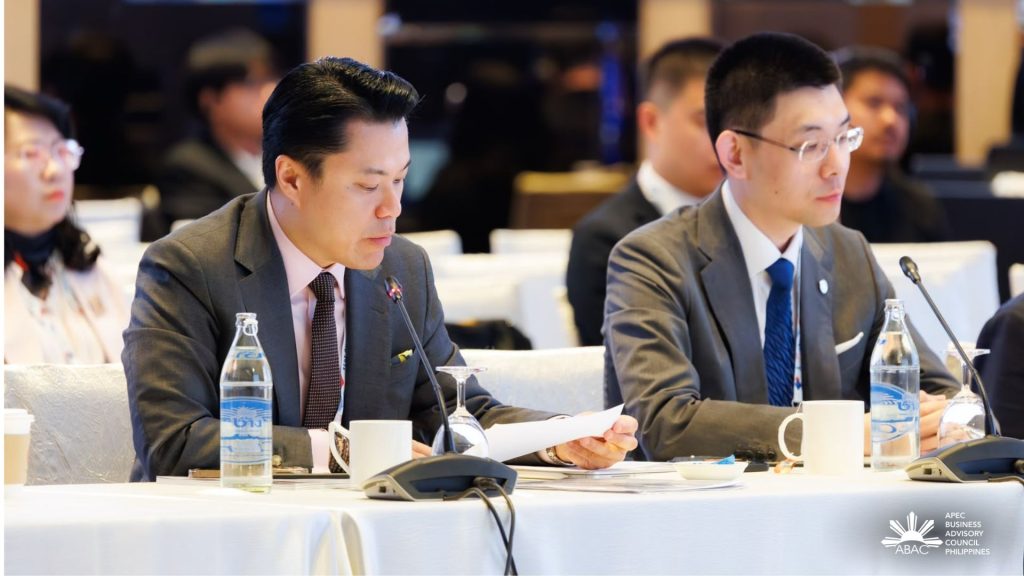
The Philippines also registered a significant contribution to ABAC’s sustainability agenda through the Sustainability Working Group. In collaboration with ABAC Philippines, William Wang, the lead author of ClimateTech in Focus 2025: AI for Sustainability, a cross-country research initiative developed together with the Philippine Pacific Economic Cooperation Council (PPECC), United Nations University (UNU), Liveable Cities Philippines, and the Sino International Entrepreneurs Federation, presented the report’s findings to the Working Group.
Following the presentation, Tan introduced recommendations encouraging APEC economies to accelerate the responsible deployment of AI, strengthen sustainable AI infrastructure, and prioritize AI applications that deliver measurable sustainability outcomes. The Sustainability Working Group endorsed the recommendations for inclusion in ABAC’s broader sustainability agenda.
Philippines Drives ASEAN-ABAC Collaboration Forward
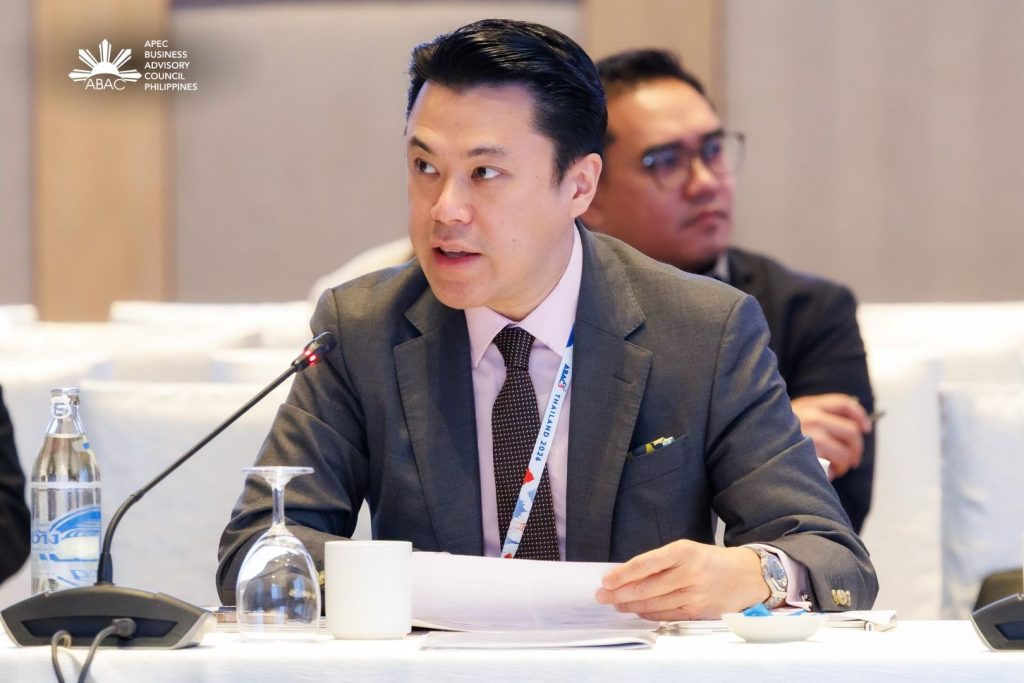
On the sidelines of the meeting, Tan chaired the ASEAN-ABAC Caucus, convening ASEAN members and dialogue partners to identify practical initiatives that can be advanced through the broader ABAC process. Guided by discussions on where ASEAN members can work more closely together and where collaboration with dialogue partners can be deepened, he highlighted key outcomes of the ASEAN Summit held in Cebu earlier this year. These included progress on the ASEAN Digital Economy Framework Agreement (DEFA), the proposed ASEAN AI Center for MSME Growth, private sector-led food security initiatives, resilient semiconductor and critical minerals supply chains, and the creative economy, identifying opportunities to better align ASEAN priorities with ABAC’s regional agenda.
The Caucus generated several proposals for continued regional collaboration. ABAC Canada encouraged ASEAN economies to adapt its AI Applied Reports for regional events, develop “plug-and-play” resources to accelerate AI adoption, and establish a network of AI and cybersecurity experts that economies can draw upon. ABAC Singapore urged members to expand participation in its Green Economy Agreements survey to inform future recommendations to APEC Leaders while strengthening cooperation on sustainable trade finance and interoperable trade-related climate measures.
The Caucus likewise received updates from the Asia-Pacific Financial Forum (APFF) and ABAC Japan on pandemic insurance, local currency digital payments, and carbon markets, with members encouraged to broaden private sector participation and deepen regional collaboration on these initiatives. Tan concluded the caucus by inviting participants to continue advancing these priorities at the ASEAN Business and Investment Summit, which the Philippines will host in Manila later this year.
_______________________________________________________________________
APEC Member Economies: Australia; Brunei Darussalam; Canada; Chile; China; Hong Kong, China; Indonesia; Japan; Korea; Malaysia; Mexico; New Zealand; Papua New Guinea; Peru; Philippines; Russia; Singapore; Chinese Taipei; Thailand; United States of America; and Viet Nam.
ABAC was created by APEC Leaders in 1995 to be the primary voice of business in APEC. Each economy has three members who are appointed by their respective Leaders. They meet four times a year in preparation for the presentation of their recommendations to the Leaders in a dialogue that is a key event in the annual Leaders Meeting.
Under China’s leadership, ABAC is pursuing a work program under the theme “Openness. Synergy. Connectivity.” to respond to the challenge of maintaining the economic vitality of the Asia-Pacific Region and ensure it benefits all.
ABAC 2026 Chair is Li Fanrong (China) and the Co-Chairs are Kyuho Lee (Korea) and Ho Sy Hung (Viet Nam), with four (4) working group chairs and one (1) task force chair, namely: Anna Curzon, Regional Economic Integration Working Group (REIWG); Julia Torreblanca, Sustainability Working Group (SWG); Jan De Silva, Digital and Innovation Working Group (DIWG); Zeng Qi, Connectivity Working Group (CWG); and Mitsuhiro Furusawa, Finance and Economics Task Force (FETF).
For further information please contact: Mr. Guillermo Luz, ABAC Philippines – Email: secretariat@abac.ph