
Chinese Vice Premier He Lifeng to APEC-BAC: “Deepen Economic Integration, Innovation, and Multilateral Cooperation”
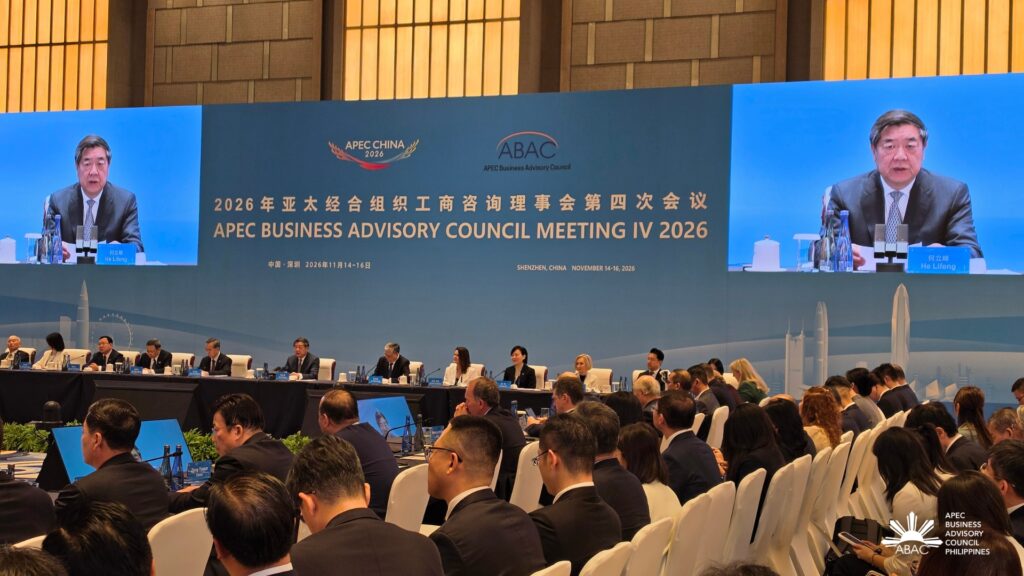
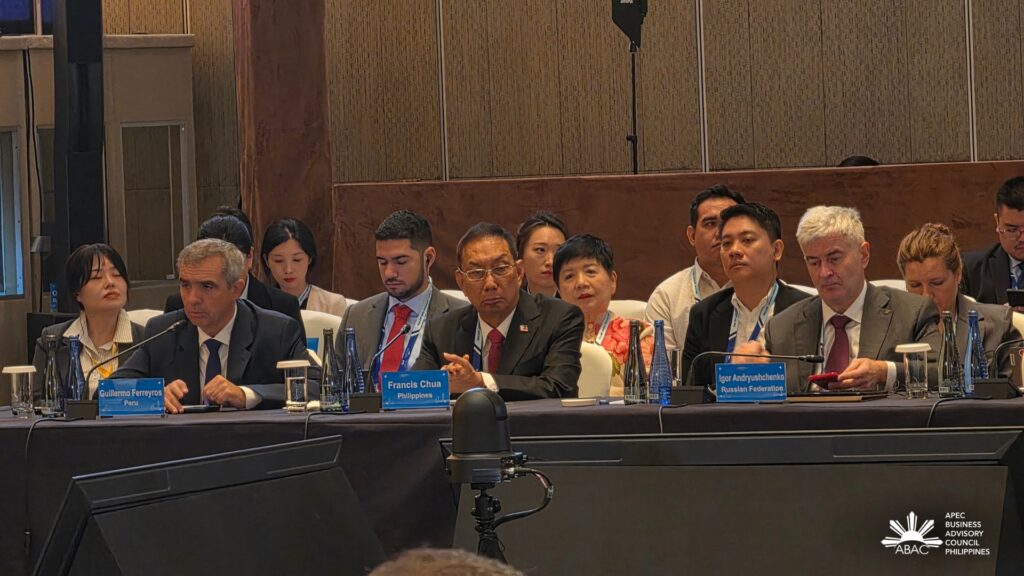
Shenzhen, China, November 14, 2026 — Ahead of the APEC Leaders’ Meeting in Shenzhen, He Lifeng, Vice Premier of the People’s Republic of China, addressed the APEC Business Advisory Council (ABAC) during the Opening Ceremony of ABAC IV. ABAC Philippines was represented by Alternate Member Amb. Francis Chua, former Special Envoy for Trade and Investments and Chairman Emeritus of the Philippine Chamber of Commerce and Industry (PCCI).
Vice Premier He called on Asia-Pacific economies and the regional business community to reject economic fragmentation and deepen mutual openness. Marking 33 years since China joined APEC—and its third time serving as host—Mr. He emphasized that regional stability, technological innovation, and rules-based multilateralism are essential to navigating global economic headwinds.
“Facts have proven that decoupling, severing supply chains, and ‘small yard, high fence’ policies cannot resolve one’s own economic predicaments,” Mr. He stated, “only connectivity and mutual openness can achieve shared win-win outcomes.”
Echoing the message of the Chinese official, Amb. Chua highlighted, ”achieving a unified single window for trade facilitation among APEC members should be paramount in our agenda. We live in a highly digitized economy wherein borders must be broken rather than raised.”
APEC at an Important Crossroads
Addressing rising risks from unilateralism, protectionism, economic fragmentation, and insufficient global growth momentum, Vice Premier He framed the upcoming Leaders’ Meeting as a critical juncture for the region. Mr. He noted that the gathering serves as a vital opportunity “to re-clarify the direction and once again rally strength for Asia-Pacific cooperation, which currently stands at a crossroads.”
Three Strategic Proposals for Regional Cooperation
Acknowledging ABAC’s pioneering role in advancing the free, open, and rules-based trade in the region, Vice Premier He emphasized the pivotal influence of ABAC in advancing three core recommendations to guide the region’s next phase of shared prosperity:
- Advance Openness, Connectivity, and Regional Economic Integration: Cautioning against geopolitical conflicts, ideological confrontation, and non-economic barriers, Mr. He supported consistent government and business discussions and partnerships to accelerate trade and investment liberalization toward building a high-standard, comprehensive, and responsive Free Trade Area of the Asia-Pacific (FTAAP).
- Become Trailblazers in Innovation and Emerging Technologies: Economies should harness the region’s abundant innovation resources, application scenarios, and market scale to accelerate digital, intelligent, and green transformations. Vice Premier He called on economies to support these development by “striving to build an open, fair, just, and non-discriminatory innovation ecosystem.”
- Defend Equality, Mutual Benefit, and Multilateralism in Economies: Vice Premier He urged economies to strengthen the World Trade Organization (WTO) and safeguard non-negotiable baselines, such as Most-Favored-Nation (MFN) and non-discrimination principles, for a more predictable and efficient trading system.
ABAC as a Core Driver of the APEC Agenda
A central element of Vice Premier He’s message was the vital role of the private sector in turning regional consensus into tangible economic outcomes. Highlighting Shenzhen as a landmark of China’s reform, opening-up, and innovation within the Guangdong-Hong Kong-Macao Greater Bay Area, he called on members of the ABAC to leverage their entrepreneurial spirit. By acting as an active bridge between governments and the private sector, ABAC members can help advance the shared vision of an Asia-Pacific community.
APEC CEO Summit and Economic Leaders’ Meeting 2026
Results from the ABAC IV Meeting will help shape the APEC CEO Summit, which takes place from November 17-18, 2026, and the APEC Economic Leaders’ Meeting, from November 18-19, 2026. Both these engagements give ABAC Members to discuss this year’s recommendations directly to Economic Leaders, government officials, and institutional partners.
APEC Member Economies: Australia; Brunei Darussalam; Canada; Chile; China; Hong Kong, China; Indonesia; Japan; Republic of Korea; Malaysia; Mexico; New Zealand; Papua New Guinea; Peru; the Philippines; Russian Federation; Singapore; Chinese Taipei; Thailand; United States of America; and Viet Nam.
ABAC was created by APEC Leaders in 1995 to be the primary voice of business in APEC. Each economy has three members who are appointed by their respective Leaders. They meet four times a year in preparation for the presentation of their recommendations to the Leaders in a dialogue that is a key event in the annual APEC Leaders’ Meeting.
Under China’s leadership, ABAC is pursuing a work program under the theme, “Openness. Synergy. Connectivity.” to respond to the challenge of maintaining the economic vitality of the Asia-Pacific region and ensure it benefits all.
ABAC 2026 Chair is Li Fanrong (China) and the Co-Chairs are Gunho Kim (Republic of Korea) and Ho Sy Hung (Viet Nam), with four (4) working group chairs and one (1) task force chair, namely: Anna Curzon, Regional Economic Integration Working Group (REIWG); Julia Torreblanca, Sustainability Working Group (SWG); Jan De Silva, Digital and Innovation Working Group (DIWG); Zeng Qi, Connectivity Working Group (CWG); and Mitsuhiro Furusawa, Finance and Economics Task Force (FETF).
For further information please contact: Mr. Guillermo Luz, ABAC Philippines at secretariat@abac.ph