
APEC-BAC Calls for Concrete Action to Strengthen Asia-Pacific Growth and Cooperation during its 30th Anniversary; Philippines Promotes Water Security and Sustainability
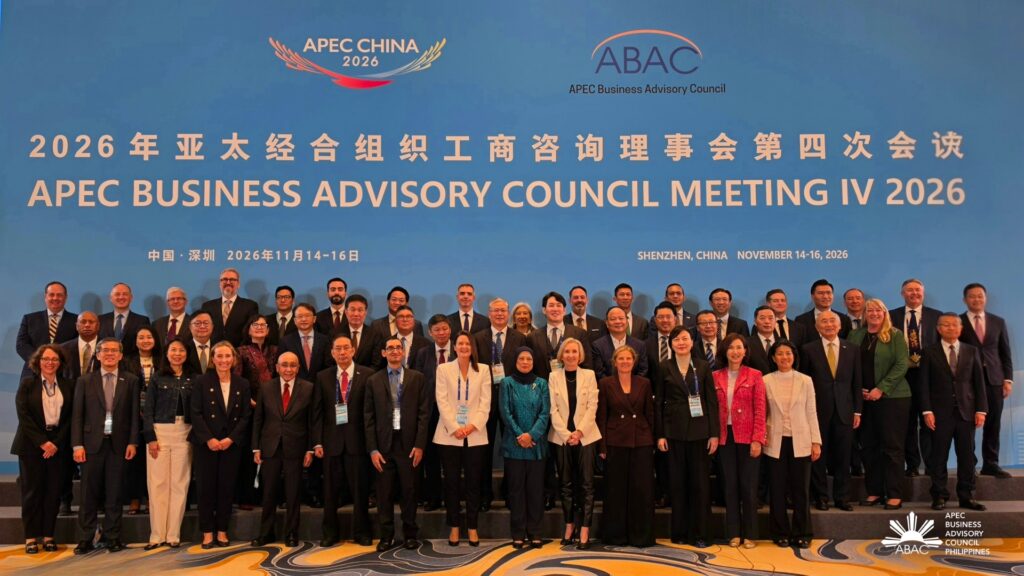
Shenzhen, China, November 16, 2026 – The APEC Business Advisory Council (ABAC) met for the fourth and final meeting of 2026 in Shenzhen, China from November 14-16, 2026. Represented by private sector leaders from the 21 APEC economies, the Council affirmed their support for institutionalizing “Openness, Connectivity, and Synergy” – the theme for 2026 – throughout the Asia-Pacific.
Concluding the meetings under China’s 2026 APEC chairmanship, ABAC welcomed Chinese Vice Premier He Lifeng’s message and reaffirmed the call for concrete action to strengthen regional growth and investment amid rising trade barriers, supply-chain disruptions and global economic uncertainty.
“Vice Premier He’s message reinforces the important role of business in building a more open, connected and prosperous Asia-Pacific. This requires practical actions that make it easier for businesses to trade, invest and innovate,” said ABAC 2026 Chair Li Fanrong.
“ABAC is an eye opening opportunity with regard on the impact and importance of AI, renewable energy and sustainability in our daily lives,” ABAC Philippines Alternate Member Amb. Francis Chua, former Special Envoy for Trade and Investments and Chairman Emeritus of the Philippine Chamber of Commerce and Industry (PCCI), shared the sentiment. He added, “these are of extreme significance among trading economies. This year’s theme allows Shenzhen and China to open more opportunities to the global field. We hope the Philippines may also continue to grow, as we share in the same vision and goals with all APEC economies.”
The Shenzhen meeting follows the release of ABAC’s 2026 Report to APEC Economic Leaders, which contains the business community’s recommendations developed over three previous meetings during the year. The Council is also preparing for the APEC CEO Summit and discussing priorities for 2027 under Viet Nam’s chairmanship.
“Despite the challenges facing our region, artificial intelligence, the digital economy and the energy transition offer enormous opportunities to raise productivity and create jobs. The Asia-Pacific can demonstrate global leadership by preserving an open and predictable environment for trade and investment while ensuring that the benefits of innovation are widely shared,” Li said.
Towards Openness, Connectivity, and Synergy in APEC
Under its 2026 theme, Openness, Connectivity and Synergy, ABAC put forward recommendations aimed at translating regional cooperation into practical benefits for businesses and communities.
On openness, ABAC calls on APEC economies to reaffirm their commitment to free, open, fair, non-discriminatory, transparent and predictable trade and investment, strengthening the multilateral trading system and accelerate progress toward the Free Trade Area of the Asia-Pacific (FTAAP) through practical, business-led early deliverables. These include tackling non-tariff barriers affecting food trade, facilitating trade in services, promoting coherent digital trade rules and expanding opportunities for MSMEs. ABAC also urged stronger action on women’s economic participation and leadership.
On connectivity, ABAC recommended greater investment in disaster-resilient and low-carbon transport infrastructure, stronger supply-chain resilience, improved maritime and air connectivity, and more efficient logistics and border procedures. It calls for wider adoption of paperless trade through the APEC Centre of Excellence for Paperless Trade (ACCEPT), modernization of the APEC Business Travel Card, and expanded people-to-people exchanges.
ABAC emphasized that connectivity extends beyond physical infrastructure to include reliable digital systems, resilient supply chains, skilled workforces and stronger human connections that enable businesses and communities to prosper together.
On synergy, ABAC call for closer public-private cooperation to mobilize investment in infrastructure, energy, healthcare, water security and climate resilience. It also emphasizes food and energy security, disaster preparedness and responsible minerals development, alongside responsible innovation-friendly governance frameworks for artificial intelligence, quantum and other emerging technologies.
A particular priority is AI for all, ensuring that MSMEs and developing economies have access to affordable technologies, digital infrastructure, skills and financing to participate fully in the digital economy. As an outcome of the meeting, ABAC launched AI Applied: Successful Use-Cases in APEC’s Traditional Industries, a report that calls on APEC economies to improve data standards and interoperability, make regulatory pathways clearer, invest in workforce training, and help smaller firms access trusted AI tools.
Taken together, ABAC’s recommendations seek to reduce business costs, strengthen resilience and ensure that the opportunities created by emerging technologies are more widely shared. The Council reaffirmed its readiness to work with APEC economies to translate these priorities into practical results.
Philippines Advances Innovations for a Resilient Water Future
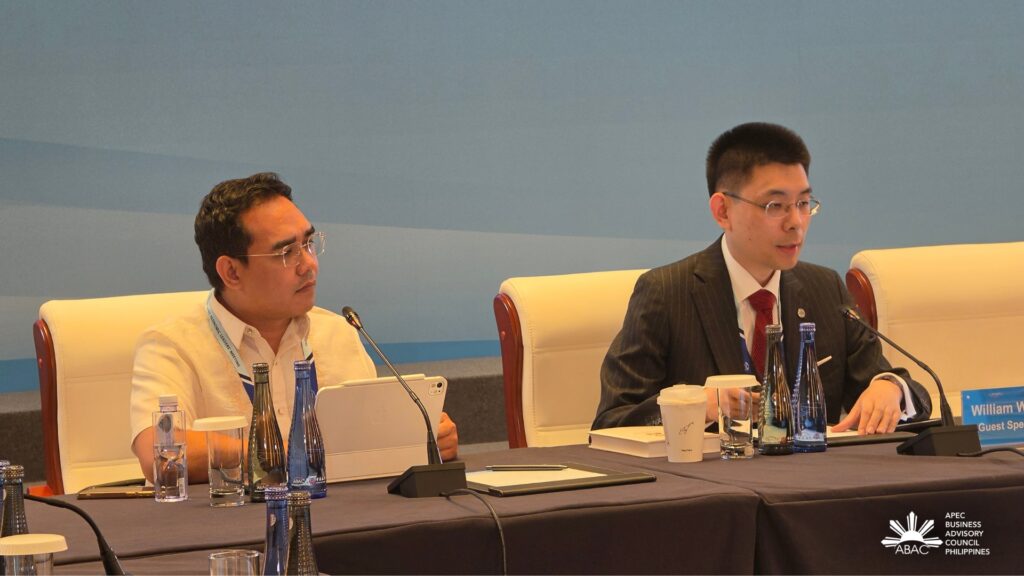
Leading to ABAC 2027, ABAC Philippines, in partnership with the Philippine Pacific Economic Cooperation Council (PPECC), United Nations University, and the Sino-International Entrepreneurs Federation (SIEF), reinforced its commitment to technological innovation for sustainable development by earning plenary endorsement to continue its involvement in the research project: ClimateTech in Focus 2026: “Innovations for a Resilient Water Future.”
Building on the momentum of previous ClimateTech in Focus editions, the 2026 report investigates how artificial intelligence (AI), the Internet of Things (IoT), and advanced computing can transform water resource management, improving climate forecasting, and strengthening ocean governance. The report aims to outline the concrete investments, policy reforms, and institutional capabilities required to build secure and sustainable water systems.
Representing ABAC Philippines Member Mr. Sabin Aboitiz, Mr. Froland Tajale introduced the proposal to continue ABAC’s involvement in the research initiative and explore strategic policy and investment recommendations for 2027. The session featured Guest Speaker, Mr. William Wang, Chief Representative for Asia Pacific of SIEF and lead author of the report, who presented the project’s background and research scope.
“Climate change and resource constraints require us to reimagine food, transport, and urban infrastructure to sustainably manage our water systems as both a humanitarian necessity and an economic opportunity,” ABAC Philippines manifested. Such measures include integrating water security into digital infrastructure investment, which can help economies ensure water availability, efficient cooling, and reclaimed water use in data centers, while engaging operators and utilities to resolve pricing and long-term supply barriers.
Through this continued partnership with PPECC and SIEF, ABAC Philippines aims to equip regional leaders and the private sector with practical, innovation-driven pathways toward a water-secure Asia-Pacific.
Upon completion, the ClimateTech in Focus 2026 report will be showcased on the global stage at the 31st United Nations Climate Change Conference (COP31) and Shanghai Climate Week 2027.
ABAC at 30
To commemorate its 30th anniversary, ABAC also launched The Architecture of Harmony, a publication bringing together reflections from former ABAC Chairs and current Members on the importance of cultural understanding, mutual respect and trust in sustaining regional cooperation.
“ABAC’s experience over the past 30 years reminds us that cooperation is built not only through policies and agreements, but also through relationships and trust. Understanding our differences and finding common ground remain essential to working together,” Li said.
Looking ahead, ABAC discussed priorities for 2027 under Viet Nam’s leadership, emphasizing continuity in regional economic integration, connectivity, digital innovation and sustainable growth, with greater focus on flagship projects and concrete deliverables to support its policy recommendations. The second meeting of ABAC will be held in Manila, Philippines in April 2027.
“Ultimately, the Asia-Pacific’s prosperity depends on our ability to remain open, connected and willing to work together. Business stands ready to help turn our shared commitments into concrete results,” Li concluded.
APEC Member Economies: Australia; Brunei Darussalam; Canada; Chile; China; Hong Kong, China; Indonesia; Japan; Republic of Korea; Malaysia; Mexico; New Zealand; Papua New Guinea; Peru; the Philippines; Russian Federation; Singapore; Chinese Taipei; Thailand; United States of America; and Viet Nam.
ABAC was created by APEC Leaders in 1995 to be the primary voice of business in APEC. Each economy has three members who are appointed by their respective Leaders. They meet four times a year in preparation for the presentation of their recommendations to the Leaders in a dialogue that is a key event in the annual APEC Leaders’ Meeting.
Under China’s leadership, ABAC is pursuing a work program under the theme, “Openness. Synergy. Connectivity.” to respond to the challenge of maintaining the economic vitality of the Asia-Pacific region and ensure it benefits all.
ABAC 2026 Chair is Li Fanrong (China) and the Co-Chairs are Gunho Kim (Republic of Korea) and Ho Sy Hung (Viet Nam), with four (4) working group chairs and one (1) task force chair, namely: Anna Curzon, Regional Economic Integration Working Group (REIWG); Julia Torreblanca, Sustainability Working Group (SWG); Jan De Silva, Digital and Innovation Working Group (DIWG); Zeng Qi, Connectivity Working Group (CWG); and Mitsuhiro Furusawa, Finance and Economics Task Force (FETF).
For further information please contact: Mr. Guillermo Luz, ABAC Philippines at secretariat@abac.ph